Farnwood
Fool Me OnceFarnwood is the Burkett family’s grand estate and enclosed family world: a home defined not only by its wealth, but by the gates, workers’ compound, and named rooms that regulate who belongs within it. Maya Stern enters it as Joe Burkett’s wife, yet never feels entirely at home there. As the investigation around the Burketts deepens, the estate shifts from an imposing domestic setting into a place where family history, suspicion, and deliberate manipulation meet.
The estate and its boundaries
Maya regards Farnwood as an old-fashioned estate for the very rich, the kind of place she once assumed belonged to history books or fiction. Its scale is not just architectural. She understands the family’s way of life as a compound whose members remain within the Burketts’ surroundings, with no one really leaving those environs. That closed world feels too large and too fancy to her, and its wealth sits uneasily with her despite her own family not having been poor. The discomfort persists even after she has married into the family.
The estate’s gate makes those boundaries concrete. Morris has worked there since the early 1980s and lives in the workers’ compound shared with Isabella Mendez’s family. When Maya drives in after Joe’s death, Morris scowls as usual, a gesture that reminds her she has married into the family but is not of its blood. His reaction may also carry grief or reflect gossip surrounding Isabella and the pepper-spray attack, though Maya cannot know which. He presses the button grudgingly, and the gate opens so slowly that its movement is almost imperceptible. The entrance is both ordinary estate security and a visible threshold between the family’s inner world and the people who serve it.
A home Maya never quite inhabits
Farnwood is also where the family tries to draw Maya and her daughter, Lily, closer. After Claire’s family leaves, Judith Burkett takes Maya’s hand and invites her and Lily to return to Farnwood. Maya declines, saying she thinks Lily needs to be home. The exchange places the estate’s claim of family refuge beside Maya’s own sense of what home should mean: the invitation is generous on its face, but it does not override her decision to keep her daughter in their own home.
The estate’s interior carries that same mixture of comfort and estrangement. Joe had built a high-tech workout room when he and Maya first moved in. Maya uses it for light weights and a treadmill, and exercise makes her feel better; afterwards, she cools herself with a bottle of beer before waking the computer and visiting CoreyTheWhistle’s website. The sequence makes Farnwood a functioning domestic space, where routine and private investigation occupy the same rooms. Yet it does not make the house feel like hers. Its amenities belong to a style of wealth that she has never been comfortable with, and the family’s extensive grounds reinforce her sense that the Burketts live inside a world of their own.
Rooms that express family power
The estate’s rooms are treated as markers of status in their own right. Judith reminds Maya that Joe’s will will be read in Farnwood Library at nine the following morning. Maya notes the family’s habit of naming rooms, a detail that turns even a location within the house into a formal part of the estate’s grandeur.
The library makes that grandeur tangible. Two stories high, it has floor-to-ceiling dark-oak bookshelves, ornate Oriental carpets, a chandelier, and two rolling ladders on cast-iron rails. A large antique globe opens to reveal a crystal decanter of cognac. Neil Burkett is already drinking from it when Maya enters with Judith and Caroline Burkett. The room stages family wealth as spectacle, while Neil’s casual access to the decanter makes the display part of everyday life for those who belong there.
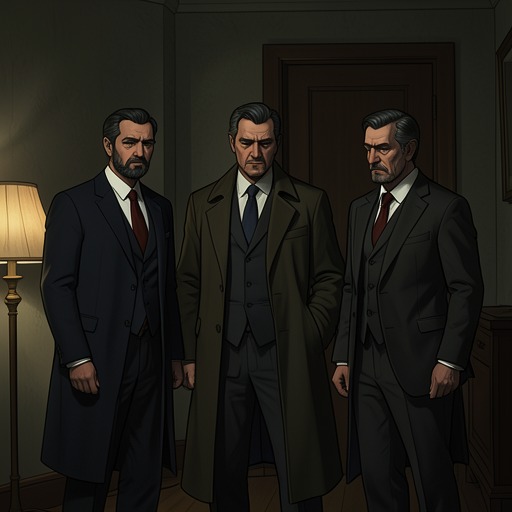
Later, Maya goes to the main house to confront Judith about Tom Douglass. The butler receives her and directs her to the parlor, a formal name for what Maya understands as a living room. Judith waits there in a black pantsuit, long strand of pearls, silver hoop earrings, and carefully styled hair, holding a crystal glass as though posed for a magazine cover. The entrance, the servant’s manner, the room’s name, and Judith’s composed appearance all establish a hierarchy before Maya gets to the question she came to ask. At Farnwood, even a private conversation takes place within a setting shaped by rank and presentation.
A place of uncertainty and return
Farnwood is closely associated with the family’s unresolved losses. In conversation with Maya, Caroline says that she was not allowed to see the bodies of either of her two brothers, both of whom died young. She links that absence to the fact that no one will officially declare Joe dead and admits that the circumstances make it feel as though both brothers could still be alive. Her statement gives the estate’s family history a specific, unsettling form: death is not only something the family grieves, but something whose proof has been withheld from her. Maya answers that they are not alive, but Caroline’s fear exposes how uncertainty persists inside the family’s private world.
Maya later returns to Farnwood through the service entrance while looking for Isabella. The compound appears empty. She considers breaking in to search for a clue, but judges that it would be risky and that she lacks time. On another occasion, tracking Hector’s truck, she finds it parked in the servants’ complex at Farnwood, then uses its travel history to identify a recurring address in a Paterson housing project that does not fit his apparent work pattern as a landscaper. The estate’s service spaces thus become part of Maya’s investigation: the workers’ area and the family residence are connected, but they are not interchangeable, and movement between them can leave clues.
The estate as a final stage
Maya’s later approach to Farnwood is more deliberate. Wearing a baseball cap, she drives Hector’s pickup truck through the back gate and proceeds to the main house after dark. Security remains present but is lax, and no one questions the familiar Dodge Ram. The contrast with the slow, grudgingly opened gate underscores how knowledge of the estate and its routines can turn its boundaries into vulnerabilities.
The house becomes the setting for Maya’s confrontation with Judith. Maya waits in the foyer as Judith returns with Neil and Caroline from an event. When Judith turns on the lights and sees her, Maya remains seated. She accuses Judith of arranging the nanny-camera stunt and of telling Rosa’s family that Maya killed Joe, explaining that the accusation could not be proved and was meant to provoke a response. Judith does not deny it; she answers that there is no law against trying to capture a killer. Farnwood, which once embodied the Burketts’ ability to shelter their family from outsiders, now frames the exposure of their own tactics. Its halls and rooms do not resolve the family’s secrets, but they provide the enclosed stage on which Maya names the deception and Judith acknowledges it.